
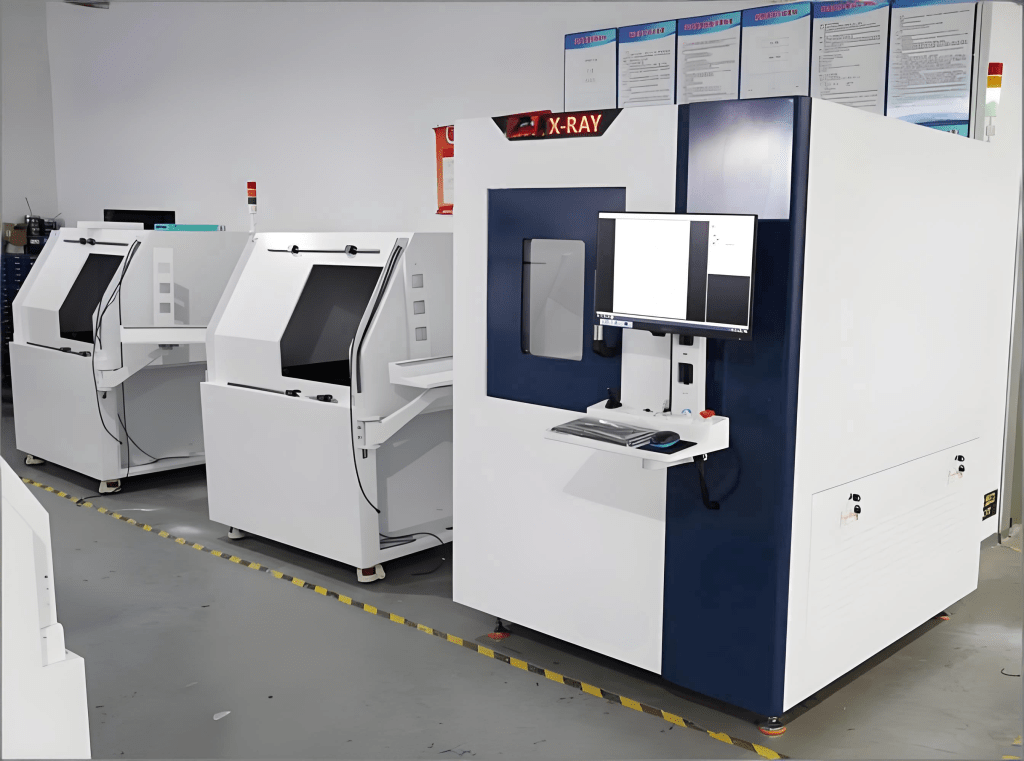


Introduction: The “Visual Awakening” in the Fourth Industrial Revolution
In Amberg, Germany, on Siemens’ electronics production line, printed circuit boards glide forward at several centimeters per second. As they pass an unassuming inspection station, multiple high-resolution industrial cameras snap synchronized images within milliseconds. The captured data is instantly sent to an edge server, where complex algorithms detect micrometer-level solder defects and, by comparing with the process parameter database in real time, trace them back to specific production steps. The system then automatically adjusts the pressure settings of the upstream placement machine. The entire process unfolds autonomously, forming a self-optimizing, self-correcting loop.
This scene is a microcosm of smart manufacturing under the Industry 4.0 paradigm. The visual inspection system is its indispensable “sensory organ.” No longer just an “automated tool” that replaces the human eye, it has evolved into an intelligent perception node — integrating data acquisition, real-time analysis, and decision feedback. Within the grand framework of the Cyber-Physical System (CPS), if the Internet of Things (IoT) is the neural network and cloud computing the central brain, then vision systems scattered across the production chain are the “sharp eyes” feeding massive, high-precision visual data to the entire organism.
The evolution of vision inspection systems mirrors the industrial revolutions themselves. The first mechanized body power; the second achieved scale through electrification; the third optimized processes via automation and IT. The fourth revolution, now unfolding, centers on data value creation and intelligent decision-making. Visual inspection systems sit precisely at the frontier between the physical and digital worlds — transforming tangible realities into quantifiable, analyzable, and traceable data streams. Their importance has never been so pronounced.
Chapter 1: From “Seeing” to “Insight” — The Paradigm Shift of Visual Inspection
To understand the central role of vision inspection systems in Industry 4.0, one must first grasp how their function and position have fundamentally changed. This transformation spans three key dimensions.
1.1 Functional Shift: From “Quality Police” to “Data Prophet”
In the Industry 3.0 era, vision systems played the role of “quality police,” stationed at the end of the line to deliver binary pass/fail decisions. Their purpose was to remove defective products — a passive, after-the-fact form of quality control.
Under Industry 4.0, they have become “data prophets.” Their mission is not merely to judge good vs. bad, but to collect vast, multi-dimensional data related to product quality throughout the process:
- Geometric features: dimensions, angles, contours, positional accuracy
- Surface features: color, texture, scratches, dents, gloss
- Assembly features: presence/absence, misalignment, polarity, gaps
- Process features: flow of materials, machine posture, equipment motion
These multidimensional data streams feed into MES, SCADA, and other platforms, where they are cross-analyzed with data from temperature, pressure, vibration sensors, and process parameters. Through machine learning, the system traces causes from results, shifting from reactive correction to predictive prevention.
For instance, if a slight color deviation is detected in a batch of coatings, data correlation might reveal that a specific spray nozzle has a preheat temperature anomaly — triggering maintenance before mass defects occur. The system thus evolves from “quality police” into a “trend analyst.”
1.2 Technical Architecture: From “Isolated Islands” to “Networked Nodes”
Traditional vision setups were isolated — a single camera, light source, and processor operating locally. Results were sent via simple I/O signals to the PLC for reject control. Data rarely left the machine.
The Industry 4.0 model connects vision systems as networked nodes:
- Interconnectivity: Using standardized protocols like OPC UA and MQTT, vision systems integrate seamlessly with PLCs, robots, CNCs, and management systems.
- Edge computing: To reduce bandwidth strain, most preprocessing and feature extraction occurs at the edge. Smart cameras or controllers upload only relevant results, achieving a “fat edge, thin cloud” balance.
- Cloud empowerment: The cloud trains models and performs deep analytics, sharing knowledge across plants globally. A defect model trained in Germany can be deployed instantly to factories in Mexico or China.
1.3 Core Value: From “Efficiency Boost” to “Innovation Driver”
Previously, vision systems were about cost reduction and efficiency. Now, their value extends far beyond:
- Enabling mass customization: Vision systems recognize product models and configurations, guiding robots in real time to support flexible manufacturing.
- Creating new business models: With continuous quality data, manufacturers can sell “uptime as a service,” offering predictive maintenance instead of just hardware.
- Accelerating R&D: High-precision vision tracking of prototypes during testing provides engineers with granular data for rapid design iteration.
Chapter 2: Integration with the Five Pillars of Industry 4.0
Visual inspection systems deeply intertwine with the core technologies underpinning Industry 4.0 — not just coexisting but mutually empowering.
2.1 Internet of Things: Vision as the Richest Data Source
Among all sensors, vision is the most data-dense. A single high-speed 3D camera generates gigabytes of data per second, feeding digital twins with rich, real-time inputs.
In smart logistics, vision-based DWS systems not only read barcodes but also measure package volume and weight, optimizing storage and routing — making every warehouse step transparent.
2.2 Big Data & AI: The Alchemy of Visual Data
Raw images hold limited value until refined by AI:
- Beyond traditional algorithms: Rule-based detection handles simple defects well, but fails with complex irregularities like random pores or surface blemishes. Deep learning (especially CNNs) extracts features automatically from large datasets, vastly improving accuracy and adaptability.
- From detection to segmentation: Deep learning can classify and delineate defects pixel by pixel, supporting root cause analysis.
- Few-shot & self-supervised learning: These methods tackle the scarcity of defective samples, learning “what’s normal” to better spot anomalies.
2.3 Cloud & Edge Computing: The Brain and Reflex Arc
Cloud platforms train models using global datasets and perform large-scale trend analysis, while edge devices execute inference in milliseconds for real-time decisions. This mimics biological reflexes — instant local reaction without central delay.
2.4 Digital Twin: Vision as the “Mirror Engine”
3D vision scanning constructs accurate virtual models of products or production lines. Real-time monitoring keeps these twins synchronized with physical reality, enabling simulation-driven optimization and closed-loop improvement.
2.5 Additive Manufacturing: Vision as the Guardian of 3D Printing
Given 3D printing’s layer-by-layer nature, small deviations can accumulate into structural flaws:
- In-situ monitoring: Vision tracks melt-pool behavior during metal printing to detect anomalies.
- Layer inspection: Each printed layer is visually checked for powder uniformity and mechanical interference.
- Precision verification: Final scans compare printed parts with CAD models, mapping deviations for process refinement.
Chapter 3: Global Practices and Shared Challenges
3.1 Regional Ecosystems
- German-speaking Europe: Prioritizes vertical integration and standardization, driven by firms like Siemens and KUKA.
- North America: Characterized by platform dominance — Cognex, Keyence, and cloud providers (AWS, Azure) define ecosystems through software accessibility.
- East Asia (China, Japan, Korea): Driven by market pull and agile innovation. China’s manufacturing scale fuels rapid adoption; Japan leads in optics; Korea excels in semiconductor and electronics applications.
3.2 Common Challenges
- Data silos and interoperability gaps
- “Black box” AI models lacking explainability
- Massive bandwidth and computing demands
- Shortage of interdisciplinary “T-shaped” talent
- Security and privacy risks in visualized factories
Chapter 4: Future Outlook — From Perceptual to Cognitive Intelligence
Visual inspection continues to evolve:
- Active Vision: Systems autonomously adjust angles or lighting to improve analysis.
- Multimodal Fusion: Combining vision with sound, temperature, or force data for holistic diagnostics.
- Causal Inference: Moving from correlation to understanding “why” defects occur.
- Human-Machine Collaboration: AI handles volume; humans handle edge cases — blending efficiency and expertise.
Conclusion: Reshaping the Eye of Manufacturing
From a craftsman’s fingertips to a technician’s magnifier to a sensor’s lens, inspection has always been about turning intuition into quantifiable knowledge.
In Industry 4.0, visual inspection stands as the visual cortex of smart manufacturing — the bridge between physical craftsmanship and digital intelligence.
It allows factories not only to see their products but to understand their processes and anticipate their outcomes. Investing in vision systems is no longer about quality assurance; it’s about core competitiveness in a data-driven age.
In this new industrial era defined by data and algorithms, those who possess the sharpest and most intelligent “industrial eyes” will perceive trends before others — and shape the future. Visual inspection, born from humanity’s ancient desire to see clearly, is now the key unlocking the next chapter of truly intelligent manufacturing.


 SMTPack LAB
留下评论