

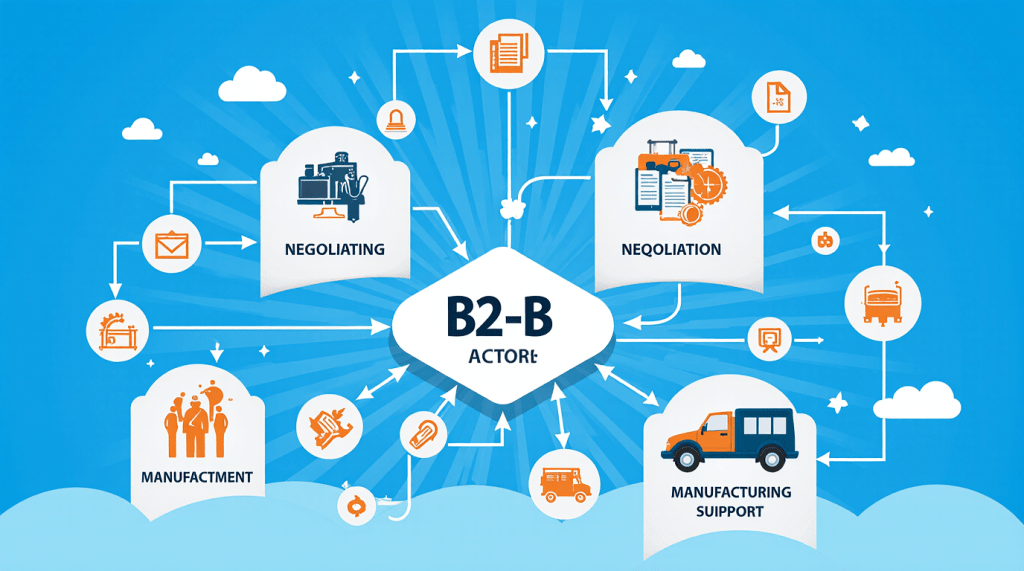
A pragmatic, milestone-driven B2B workflow for customized SMT automation (tape-and-reel, tray loaders, programmers, AOI, and online laser marking). Clear inputs from buyers, rapid feasibility checks, documented proposals, staged payments, FAT/SAT acceptance, and structured after-sales support reduce lead time and risk. Use this guide to prepare samples, floor plans, MES/ERP data, and contacts to accelerate delivery and achieve reliable performance.
Table of Contents
1. Pre-communication (Requirements)
3. Contract & Payment Terms (B2B T/T)
5. Shipping, Installation & SAT
6. Training, Warranty & After-sales
7. Buyer Preparation Checklist
1. Pre-communication (Requirements)
This stage begins when a buyer expresses interest in a tailored piece of equipment. Early, precise information shortens lead time and reduces engineering rework. We do a quick feasibility check and give high-level guidance within 1–2 business days.
Buyer should provide
- Product sample(s) or high-resolution photos and detailed specifications (dimensions, materials, packaging orientation).
- Target throughput (units/hour or units/day) and expected yield/acceptance rate.
- Precision/tolerance requirements (e.g.,
±0.05 mm) and a list of compatible product types. - Production environment: floor plan, available footprint, ceiling height, power (voltage / phase), compressed air specs.
- MES / ERP / PLC integration requirements and any API or communication documents (OPC-UA, TCP/IP, REST, etc.).
- Desired delivery window and the buyer’s internal approval/acceptance workflow (who signs off at FAT/SAT).
Our initial response (within 1–2 business days)
- Quick feasibility assessment and major constraints.
- High-level configuration options and expected performance range.
- Request for any missing samples, photos, or technical specs.
- Suggested next steps and an estimated timeline for a formal proposal.
Pro tip: Provide 2–3 representative samples and a single technical contact to reduce clarification rounds.
2. Proposal & Quotation
After feasibility confirmation, SMTPack LAB issues a formal technical proposal and quotation. The proposal documents the transition from concept to a scoped project with clear deliverables.
Proposal contents
- Device configuration, key components, and a preliminary Bill of Materials (BOM).
- Performance targets (precision, cycle time, compatibility range).
- Integration outline: MES/PLC interfaces, data points, traceability fields.
- Project timeline with milestones: detailed design → procurement → assembly → FAT → shipment → SAT.
- Acceptance criteria for FAT and SAT, deliverables, and reporting format (video, logs, FAT report).
Quotation & revision rounds
We provide a written quotation. Buyers may request revisions; each iteration updates scope, cost, and schedule. Typical proposal and clarification cycles run 3–7 business days depending on complexity.
3. Contract Signing & Payment Terms (B2B T/T)
When the buyer approves the proposal, both parties sign a Purchase Agreement that captures specifications, delivery & acceptance criteria, warranty, liabilities and the payment schedule.
Standard payment schedule (example)
- Deposit — 50%: paid after contract signing to commence engineering and procurement.
- Progress — 30%: paid after assembly & internal FAT or before shipment, as agreed.
- Final — 20%: paid after successful SAT acceptance, or per contractual terms.
Payment confirmation process
Buyer should email the bank remittance slip or SWIFT advice to info@smtpacklab.com after transfer. Bank details are included in the contract/invoice.
4. Manufacturing & Factory Acceptance Test (FAT)
Production begins after deposit and finalized drawings. For custom systems, typical lead time from drawing confirmation to FAT is 20–30 working days, subject to part availability and custom options.
Manufacturing steps
- Procurement of long-lead and critical components.
- Mechanical fabrication, precision machining and sub-assembly.
- Electrical wiring, control cabinet assembly, and software integration.
- Bench-level tuning, integration tests and internal QA.
Factory Acceptance Test (FAT)
We perform full functional tests using customer-provided or representative materials. FAT deliverables include test videos, logs, and a signed FAT report. Buyers may attend on-site or remotely by video conference.
Example timeline (click to expand)
Day 0  – Deposit received, final drawings confirmed
Day 1–7  – Parts procurement & initial machining
Day 8–18 – Assembly, wiring & control programming
Day 19–22 – Internal tuning & FAT
Day 23   – FAT report, customer review and feedback
Note: This is an indicative schedule. Large-scale or heavily customized orders can extend lead time.
5. Shipping, Installation & Site Acceptance Test (SAT)
After FAT approval and agreed progress payment, we prepare packing and shipment. Shipping lead time depends on destination, carrier and customs requirements.
Pre-shipment checks
- Complete labeling, documentation (packing list, commercial invoice, certificates).
- Coordinate logistics, insurance and ETA with buyer.
- Verify crating and shock / humidity protection for sensitive components.
On-site installation & SAT
- On-site installation, electrical hook-up and mechanical alignment by SMTPack engineers.
- Calibration and trial runs using buyer’s actual materials to confirm process stability.
- Buyer signs SAT acceptance form when agreed performance criteria are met.
6. Training, Warranty & After-sales Support
Our post-delivery program ensures smooth handover and long-term reliability.
Training program
- Operator training: start/stop, changeovers, first-line troubleshooting.
- Maintenance training: daily checks, lubrication, monthly inspections and socket replacement guidance.
- SOPs, quick reference guides and training materials provided in digital and printed format.
Warranty & service
- Standard warranty: 12 months from successful SAT acceptance (contractual terms apply).
- Remote technical support via email/phone; prioritized response per SLA.
- On-site support typically provided within 48–72 hours depending on region and contract.
- Optional spare-parts kits and extended maintenance contracts available.
Support response examples (click to expand)
- Remote response: within 8 business hours (standard support).
- Critical on-site visit: typically within 48–72 hours (depending on location/SLA).
- Priority spare parts: express shipping available under extended service agreements.
7. Buyer Preparation Checklist
To speed procurement and reduce risk, buyers should prepare the following before contract signing:
- Representative samples, product drawings, and packaging information.
- Factory floor plan indicating machine footprint and utility points (power, compressed air, network).
- MES/ERP integration documents (API/OPC/TCP details) if required.
- Procurement contact, accounts payable contact, and expected PO timing.
- Clear delivery window and internal acceptance workflow.
8. Risks & Key Notes
Be practical — the most common causes of delay or additional cost:
- Late delivery of critical components from suppliers.
- Frequent design changes after production starts.
- Customs/import delays for cross-border shipments.
- Incomplete on-site preparations (power, compressed air, network, foundation).
Recommendation: Freeze specifications before production and designate a single buyer contact to speed approvals and reduce ambiguity.
Contact & Next Steps
Ready to start? Send your initial requirements pack (specs, samples, photos, floor plan) to:
SMTPack LAB
Email: info@smtpacklab.com
Website: smtpacklab.business.blog
Contact page: Contact Us Email Requirements Pack Back to Home | Contact Us
© SMTPack LAB — tailored SMT automation with clear milestones and reliable support.


 SMTPack LAB