
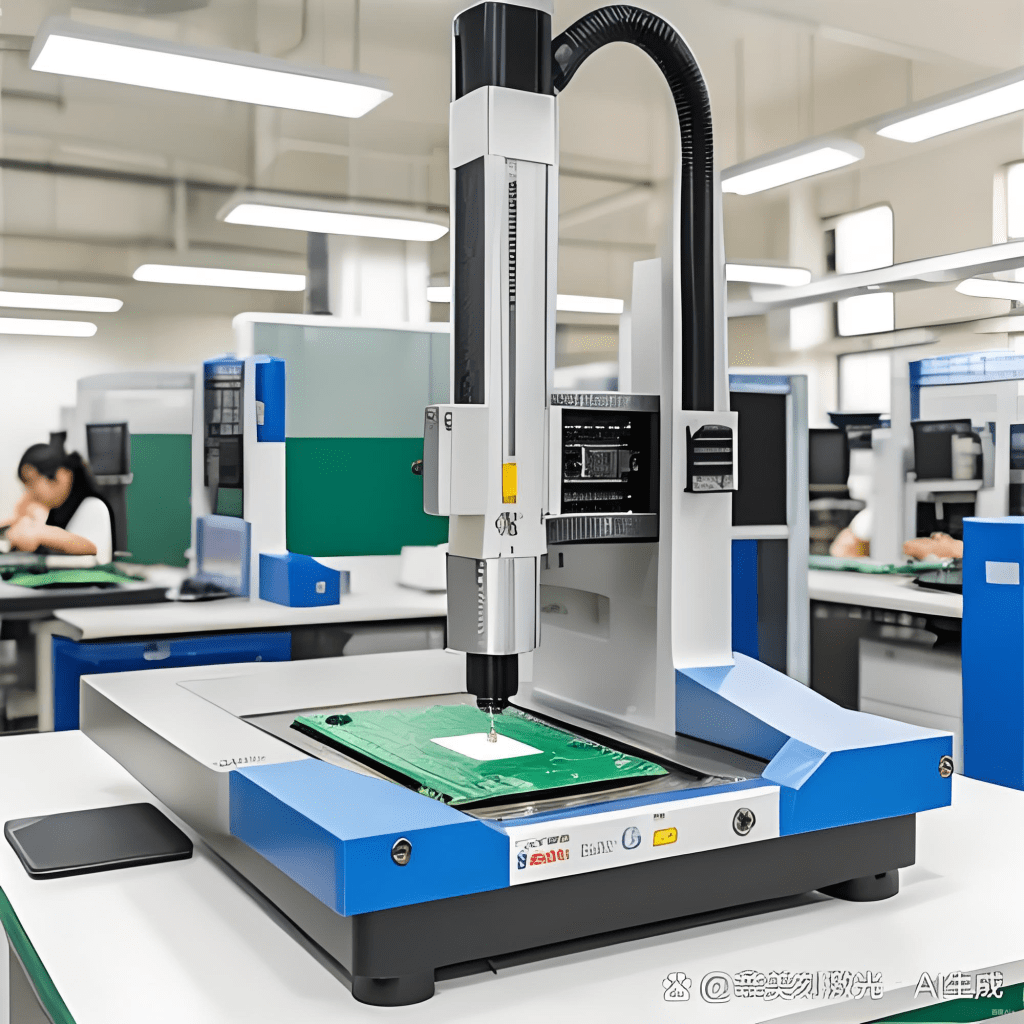


Efficient calibration of laser markers is the core link to ensuring their processing accuracy and production efficiency. To help you systematically understand and implement calibration work, this report will revolve around the following framework: Analysis of Calibration Value Dimensions, Analysis of Mainstream Efficient Calibration Technologies, Step-by-Step Implementation Process, Industry Application Cases, and Future Development Trends.

🔎 Comprehensive Research Report on Efficient Calibration of Laser Markers
1 Analysis of Calibration Value Dimensions and Common Issues
The calibration of laser markers is far from a simple parameter adjustment; it is a key link that directly affects the equipment’s comprehensive performance, production costs, and product quality. Deeply understanding its value dimensions and the drawbacks of traditional methods is the foundation for implementing efficient calibration.
1.1 Accuracy and Stability Dimension
Calibration accuracy directly determines the quality baseline of the marking results. In multi-laser equipment, if the alignment accuracy in the laser stitching area has micron-level deviations, it will produce defects such as visible seams, overlapping over-burning, or gap defects in the stitching area. This is absolutely unacceptable in high-end manufacturing fields such as aerospace and medical devices. For example, large-sized components in the aerospace field have extremely high requirements for part forming quality, dimensional accuracy, and surface quality.
More critically, equipment that is not optimally calibrated is in a metastable state: its optical system (such as galvanometers, lenses) will slowly drift due to disturbances from external factors like ambient temperature fluctuations and mechanical vibrations, causing the initial calibration state to gradually become invalid. This slow performance degradation is often difficult to detect but continuously produces non-conforming products, posing a significant challenge to quality control.
1.2 Efficiency and Cost Dimension
The consumption of time and economic costs by traditional calibration methods far exceeds the estimates of most users. Taking a four-laser equipment as an example, a comprehensive calibration can take up to 180 minutes, during which the equipment must be completely shut down. This calibration not only consumes a lot of production time but the process itself is also extremely cumbersome:
- Sample Printing: Traditional calibration requires specially printing test samples, consuming expensive materials such as metal or polymer powders.
- Offline Inspection: After printing, the samples need to be sent to the measuring room for coordinate measuring machine (CMM) inspection or optical scanning.
- Parameter Adjustment: Manually adjust equipment parameters based on the inspection results, and then repeat the above process until standards are met.
This “print-measure-adjust” cycle typically needs to be repeated 3-5 times, consuming large amounts of materials and man-hours, becoming an invisible killer of production cost control.
1.3 Operational Threshold and Personnel Dependence
Traditional calibration methods heavily rely on the experienced judgment and technical intuition of the operator. Experienced technicians can accurately judge the offset direction and magnitude of laser stitching by observing the microscopic characteristics of the marking traces and adjust the galvanometer control parameters based on experience. This “craftsman-like” calibration method brings two core problems:
- Personnel Dependence: Calibration quality is strongly correlated with the operator’s skill, leading to significant differences in calibration results between different personnel and different time periods.
- Difficulty in Knowledge Transfer: Tacit knowledge is difficult to systematize, accumulate, and pass on; personnel turnover directly threatens production stability.
2 Analysis of Key Efficient Calibration Technologies
In response to the many pain points of traditional calibration methods, a series of innovative technologies and methods have emerged in recent years, fundamentally reshaping the calibration process of laser markers.
2.1 Automatic Stitching Calibration Technology
The automatic stitching calibration technology introduced by Farsoon represents the latest advancement in this field. Its core technical principle achieves “one-click” fully automatic calibration through high signal-to-noise ratio signal processing technology and dedicated algorithms. The workflow of this technology is as follows:
- Laser Path Collection: The system automatically controls each laser head to move along a specific path, collecting the laser’s actual position data in real-time through high-sensitivity sensors.
- Offset Calculation: Dedicated algorithms compare the difference between the theoretical path and the actual path, precisely calculating the laser offset in each working area.
- Galvanometer Parameter Correction: The system automatically adjusts the galvanometer control parameters based on the calculation results and generates a correction file.
- Integrated Printing Preparation: Deeply integrates the calibration process into the printing preparation stage, without requiring separate production time.
This technology compresses the traditional 180-minute calibration process to be completed within 10 minutes, improving efficiency by over 95%, while controlling the calibration accuracy to < 30μm, with 100% of measurement points having errors < 10μm.
2.2 Software-Hardware Collaborative Calibration Method
In large-format marking applications, relying solely on software correction cannot overcome the distortion problems caused by the inherent characteristics of the optical system. The software-hardware collaborative calibration method achieves accuracy unification across the entire working surface by combining hardware benchmarks and software compensation.
The specific implementation process is: first, obtain an array of reference points evenly distributed on the marking surface through high-precision measurement equipment, forming a mapping relationship between the actual position coordinates and the theoretical coordinates; then, based on this mapping relationship, the control system corrects the marking path in real-time through coordinate transformation algorithms. This method effectively solves geometric distortions inherent to optical systems, such as pincushion distortion and barrel distortion.
2.3 Dynamic Focusing System Optimization
In large-format marking applications, the laser beam experiences focal length changes due to differences in propagation distance in different working areas, leading to increased spot size and decreased energy density at the edges. Optimizing the dynamic focusing system is key to ensuring consistent marking quality across the entire working surface.
Research shows that by optimizing the motion trajectory of the collimating beam expansion system, the focusing performance can be improved by 20%, achieving laser marking with a small spot size and large range. The specific method involves using polynomial fitting for the trajectory of the beam expander lens to increase the marking speed, and adopting a piecewise linear interpolation lookup table method to correct the pincushion distortion in the edge parts.
2.4 Intelligent Path Planning Algorithms
The planning quality of the laser marking path directly affects the processing efficiency and effect. The application of intelligent optimization algorithms such as genetic algorithms in path planning can significantly shorten the idle travel path and improve marking efficiency.
Research shows that optimizing the laser path through genetic algorithms can improve laser marking efficiency by 25%. The algorithm continuously evolves better path solutions by simulating the natural selection process, significantly reducing processing time while ensuring marking quality.
3 Systematic Implementation Process for Efficient Calibration
Achieving efficient calibration of laser markers requires following a systematic implementation process to ensure precise connection and orderly progress of all links.
3.1 Preliminary Preparation and Equipment Status Check
Adequate preparation is the foundation for successful calibration, including the following key steps:
- Environmental Stability Confirmation: Ensure the calibration environment temperature and humidity meet equipment requirements, avoiding the influence of external vibration sources. The ideal environment should maintain temperature fluctuation within ±1°C and humidity at 50% ±10% RH.
- Optical Component Cleaning and Inspection: Carefully clean the surfaces of all lenses using professional optical cleaning tools, including full reflectors, partial reflectors, beam expanders, focusing lenses, etc. Check lenses for defects such as scratches and coating damage.
- Equipment Warm-up: Turn on the laser and control system for a warm-up of at least 30 minutes to allow all components to reach a stable working state.
- Mechanical Structure Check: Check the fastening of moving parts such as galvanometers and guide rails to ensure there is no looseness or abnormal wear.
3.2 Calibration Execution and Parameter Recording
Execute specific calibration work according to the following process and record key parameters in detail:
- Reference Position Determination: Use high-precision positioning devices to determine the benchmark origin of the marking plane and establish a unified coordinate system.
- Automatic Stitching Calibration: Run the automatic stitching calibration system to complete path synchronization and stitching area optimization for multiple lasers.
- Focal Length Calibration: Precisely measure and adjust the focal position in each working area using a laser interferometer or a dedicated focus detection device.
- Power Consistency Calibration: Measure the output power of each laser head through a power meter, adjust it to the set value, and ensure the fluctuation range is < ±2%.
- Marking Accuracy Verification: Select at least 25 distribution points on the marking plane, mark standard graphics, and measure their positional accuracy.
During the calibration process, be sure to record the following key parameters: ambient temperature and humidity, calibration date and personnel, power readings of each laser, offset in the stitching area, focal length adjustment values, etc., to establish a complete equipment calibration file.
3.3 Verification and Continuous Optimization
After calibration is completed, comprehensive effect verification is required, and continuous optimization is carried out based on production feedback:
- Standard Test Pattern Marking: Mark standard graphics containing straight lines, arcs, and complex curves, and measure key dimensional accuracy.
- Microscopic Inspection of Stitching Area: Use a high-power microscope to inspect the trace quality in the multi-laser stitching area to ensure no obvious stitching marks.
- Long-term Stability Monitoring: Establish a regular inspection system, conduct random checks on key accuracy indicators weekly, and promptly detect performance drift trends.
- Parameter Optimization Iteration: Fine-tune calibration parameters based on the marking effects of different types of materials, and establish a material-parameter correspondence database.
4 Industry Application Case Analysis
The application of efficient calibration technology in different industries demonstrates its specific value in improving production efficiency and product quality.
4.1 Aerospace Field
The aerospace field has extremely stringent requirements for large-sized metal components, requiring not only extremely high structural strength but also strict standards for dimensional accuracy and surface quality. Multi-laser marking systems using efficient calibration technology have achieved large-area precision marking above 600mm format, ensuring the permanence and high readability of part identification.
In specific applications, through automatic stitching calibration technology, the calibration time for a four-laser equipment was reduced from 3 hours with traditional methods to 10 minutes, while ensuring stitching error < 15μm throughout the entire marking area, meeting the identification and traceability requirements of aerospace parts in high-temperature, high-vibration environments.
4.2 Precision Mold Industry
Precision molds have very high requirements for surface quality and dimensional accuracy, especially molds with complex runner structures, where their identification often needs to be directly marked on irregular surfaces near the cavity. Through the combination of dynamic focusing optimization technology and accuracy correction, contour marking on curved surfaces is achieved, ensuring character consistency and clarity.
Actual application data shows that after efficient calibration, the system controls the full-plane focal drift within ±0.02mm in a 300mm × 300mm working area, significantly improving the quality and efficiency of mold identification.
4.3 Medical Implant Field
Medical implants such as artificial joints, bone plates, etc., often have complex surface morphologies, and the materials are mostly difficult-to-process materials such as titanium alloys and cobalt-chromium alloys. The identification marked on these implants must meet special requirements of no burrs, no sharp edges, and high biocompatibility.
Through the combination of software-hardware collaborative calibration and dynamic focusing technology, high-quality marking on complex surfaces is achieved, ensuring that the identification does not affect the function and safety of the implant. At the same time, automatic stitching calibration technology enables multi-laser equipment to maintain extremely high stability and consistency when completing large batches of medical implant marking, meeting the strict standards of the medical industry.
5 Future Development Trends and Prospects
Laser marking calibration technology is rapidly developing towards intelligence, automation, and integration. The future will show the following obvious trends:
5.1 Intelligent and Adaptive Calibration
With the development of artificial intelligence technology, future laser marking systems will have self-learning and adaptive capabilities. The system can intelligently predict the optimal calibration cycle and parameter combination based on historical calibration data, equipment operating status, and environmental parameters. When performance drift is detected, the system can automatically start the calibration procedure, achieving “seamless calibration” – without affecting the normal production process during calibration.
5.2 Accelerated Standardization Process
With the successive introduction of calibration specifications for equipment such as laser line projectors, the standardization system in the field of laser marking is continuously improving. In the future, more national and international standards for calibration for different industries and different accuracy grades will emerge, providing a unified basis for the evaluation of laser marking quality. Standardization will not only help regulate the market but also lower the technical threshold for equipment use and maintenance.
5.3 Cloud Platform and Big Data Analysis
Cloud platform-based calibration data management systems will become standard configuration. Through big data analysis of calibration data from multiple devices and regions, common factors affecting equipment accuracy can be identified, and calibration strategies can be optimized. Equipment manufacturers can analyze performance degradation data of global equipment to improve product design, provide early warnings for potential failures, and achieve predictive maintenance.
6 Conclusion
Efficient calibration of laser markers is a key link to achieving the peak performance of the equipment, having evolved from a “necessary maintenance procedure” to a “core competitiveness element“. By adopting advanced technologies such as automatic stitching calibration, software-hardware collaborative correction, and dynamic focusing optimization, enterprises can improve calibration efficiency by over 95%, stabilize accuracy at the micron level, and simultaneously significantly reduce technical dependence on operators.
With the continuous development of intelligent and standardized technologies, laser marking calibration will become more precise, efficient, and convenient, providing solid support for the digital transformation and intelligent upgrade of manufacturing. Grasping the development trend of efficient calibration technology and implementing a scientific calibration management system is of vital strategic significance for enterprises to improve production efficiency, ensure product quality, and reduce operating costs.


 SMTPack LAB
留下评论